
Zakrzówek Park
Zakrzówek Park is a former limestone quarry in Kraków’s Dębniki district, flooded in 1990. The Municipal Greenery Authority puts the park at over 50 hectares, about 100 with the adjoining land, and the lake’s greatest depth at about 32 metres. The limestone underfoot formed about 160 to 150 million years ago.
A quarry that filled in 1990
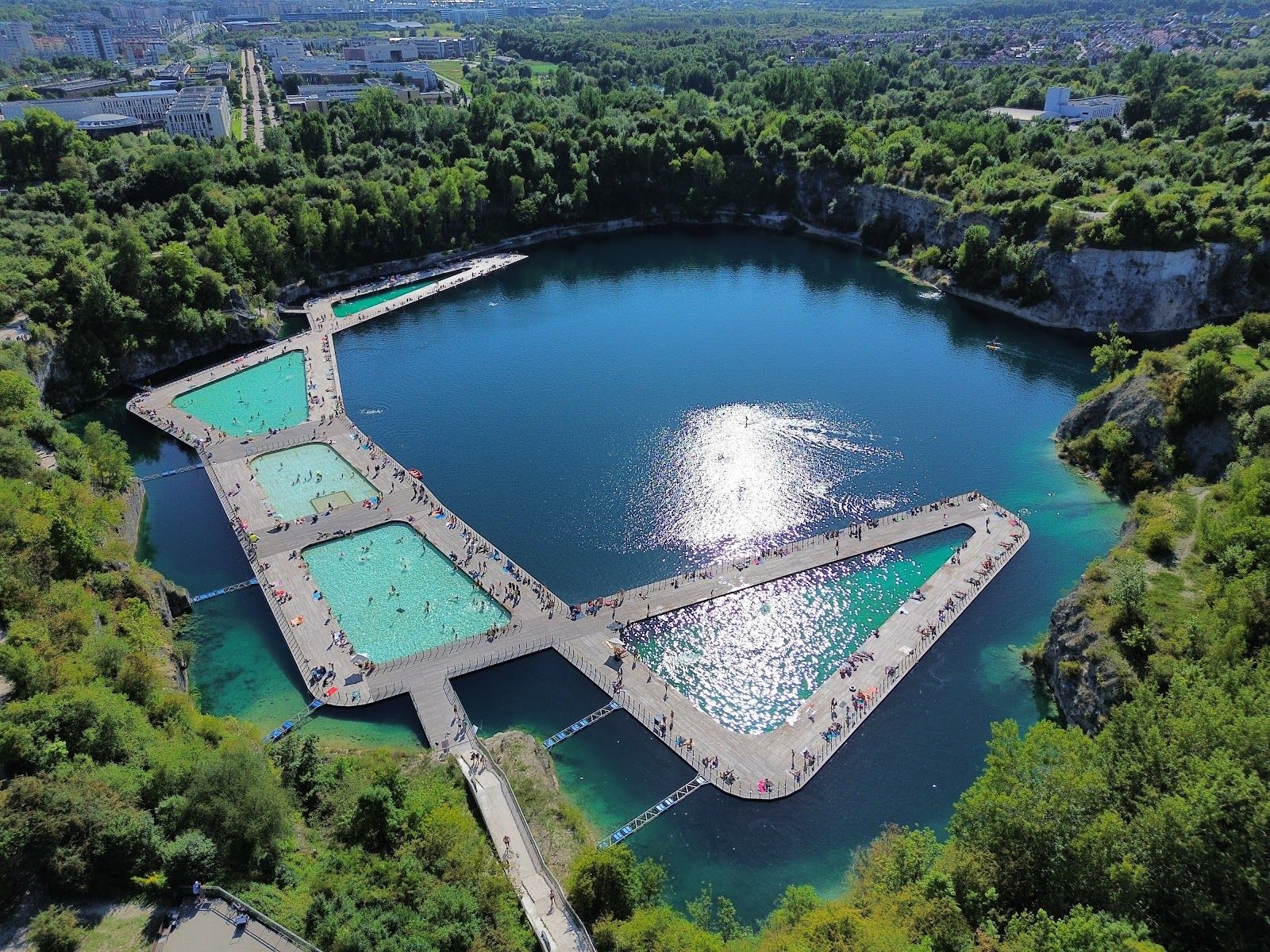
The Municipal Greenery Authority runs Zakrzówek Park in District VIII, Dębniki, between ul. Tyniecka and ul. Kapelanka, by ul. Norymberska and the Vistula. The park page calls it a former quarry turned into a reservoir, over 50 hectares, and with the neighbouring land about 100 hectares of green ground close to the centre of the city. Lake Zakrzówek formed in 1990 when the old limestone quarry was flooded. The authority gives the greatest depth as about 32 metres and ties the colour of the water to the limestone that used to be cut here. The recent works, it says, were meant to open that space with infrastructure anyone could use.
The published kit is specific. There is a bathing place with toilets, changing rooms and showers. Openwork pools float on the reservoir at different depths: a pool 40 centimetres deep for people who cannot swim, including children, and pools 3.5 metres deep for practised swimmers. The authority says the average depth of the water around the piers is about 20 metres, so swimming outside the marked bathing area, or outside its hours, is at your own risk. The floating pools in the so-called small reservoir hold 600 people. A cap on entry to the whole site is there to keep the place small in feel, to keep the water clean and to protect the nature. The authority asks swimmers to use sun products without petroleum derivatives, artificial dyes, parabens and silicones. The floating piers are also a walk, and they stay usable all year, linking parts of the park. A Water Sports Centre building stands by the large reservoir. How it would be run was set after public consultations with Kraków residents.
Paths, rock, and ground you do not enter
Away from the water the park lists walking paths, marked running paths measured for training, drinking fountains, workout zones, ping-pong tables, climbing walls, viewpoints, swings, a picnic place and a bathing zone for dogs. The geology paragraph dates the limestone to about 160–150 million years ago, laid down in a warm shelf sea. Quarry remains sit in that older landscape. The plant count is given as close to a quarter of the Polish flora of vascular plants. The community the authority calls the most valuable is the dry limestone grassland, and it names the plants: common rockrose, spiked speedwell, rock garlic, scabious knapweed, meadow sage, salad burnet, houseleek, and the grasses quaking grass, tall oat-grass, soft brome, upright brome and feather grass, plus warm scrub of wild rose, hawthorn, dogwood and buckthorn. Walnut, boxelder, goldenrod and wood small-reed are listed as alien or invasive and are being removed.
Protected amphibians recorded here are the smooth newt, the great crested newt, the fire-bellied toad, the common toad and green frogs. Reptiles are the grass snake, the sand lizard and the smooth snake. Insects and birds use the flowers. Zones marked as valuable for amphibians and reptiles may be entered only with the park manager’s consent. The authority’s line is that on this post-industrial ground the visitor is the guest.
FAQ
Is there a step-free path, and which stop do I use?
The park page does not describe a lift or a step-free route. Buses 101, 112, 162, 194, 219 and 578, and trams 11, 17, 18, 22 and 52, serve the area. The named stops are Park „Skały” Twardowskiego, Kapelanka, Grota-Roweckiego and Norymberska. The walk from each stop is not printed. The office of the Municipal Greenery Authority is ul. Reymonta 20, 30-059 Kraków.
Can I swim anywhere in the quarry?
The marked bathing area has floating pools, a 40-centimetre pool for non-swimmers and 3.5-metre pools for practised swimmers. The small-reservoir pools hold 600 people. Average depth around the piers is about 20 metres, and the lake’s greatest depth is about 32 metres. Swimming outside the marked area, or outside bathing hours, is at your own risk. The page does not print those hours or a ticket price.
Are dogs allowed, and are any areas closed?
A dog-bathing zone is listed. Zones marked for amphibians and reptiles may be entered only with the park manager’s consent. The authority also asks swimmers to avoid sun products that contain petroleum derivatives, artificial dyes, parabens or silicones.