
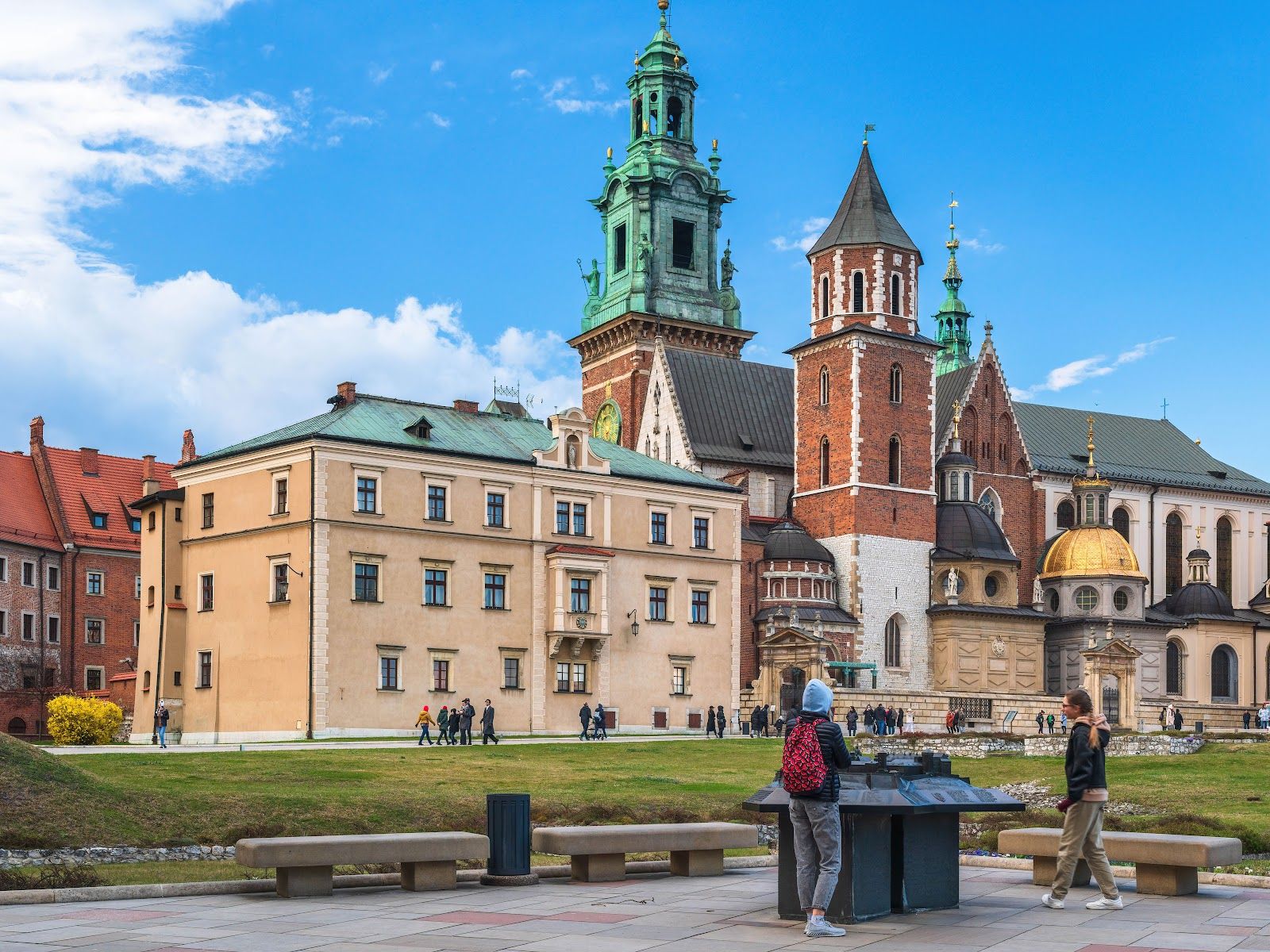
Wawel Cathedral
The Sigismund Bell at Wawel Cathedral weighs 12,600 kg. It was cast in Kraków in 1520 by Hans Behem of Nuremberg and first rang on 13 July 1521. The present Gothic church was consecrated on 28 March 1364.
The church consecrated in 1364
The history page starts from an older building. The Romanesque church, worn by time and by the fire of 1305, was judged not grand enough for the main church of the Kraków diocese. Bishop Jan Muskata began a replacement. Only the foundations of a Gothic polygonal chancel were built. The cathedral that is still standing went up in two stretches: the chancel with its ambulatory from 1320 to 1346, then the body of the aisles from 1346 to 1364, under bishops Nanker, Jan Grot and Bodzanta. Several masonry workshops followed one another. Consecration was on 28 March 1364.
The plan is a three-aisled basilica with a transept, and a chancel on a rectangular plan with an ambulatory. As soon as that Gothic church was up, bishops and magnates added chapels along the outside walls. That went on through the 14th and 15th centuries. The Renaissance inside the building, and the history page says in Poland generally, begins with Francesco the Florentine's sarcophagus of King Jan Olbracht, who died in 1501. The break with the older church is the Sigismund Chapel.
Coronations, then the crypts
For four hundred years this was the church of Polish kings. From Władysław the Short, every Polish king was crowned here except two: Stanisław Leszczyński and Stanisław August Poniatowski. The first of those ceremonies was on 20 January 1320, Władysław the Short and Jadwiga of Kalisz. From then, coronations, weddings, baptisms and funerals of the royal family were held at the high altar. The cathedral's own list of coronations runs from that January day to Augustus III and Maria Josepha of Austria on 17 January 1734.
Władysław the Short was also the first king buried at Wawel. Early kings lay in chambers under the floor. Separate chapel burials start after the death of Kazimierz IV Jagiellon in 1492. The first of those chapels was the Holy Cross, painted by Ruthenian painters, with his sarcophagus by Wit Stwosz, which the page calls a masterpiece of late Gothic. Jan Olbracht's sarcophagus uses a Renaissance triumphal arch to a design by Francesco the Florentine. His mother, Elizabeth of Austria, commissioned it.
The Sigismund Chapel was commissioned by Sigismund I the Old, designed by Bartolomeo Berrecci, and built from 1519 to 1533 by Italian sculptors. The royal page calls it a jewel of the Renaissance in Central Europe. Neither Sigismund nor his successors, nor other members of the royal families, were buried in the chapel. They were buried in the crypts underneath. The page names the sarcophagi of Sigismund Augustus, Stefan Batory and Sigismund III, and the gilt copper coffins of Władysław IV and Cecylia Renata, as sculpture in their own right.
Other chapels belong to bishops. Jan Konarski's sarcophagus, from Berrecci's workshop, is in the Chapel of the Immaculate Conception, fitted out as his mausoleum in 1520–1521. Bishop Piotr Tomicki's chapel, also by Berrecci, was the first domed chapel in Poland besides the Sigismund Chapel. What survives of its furnishings is the founder's sarcophagus, parts of the altar, a painting of the Adoration of the Magi, and a relief of God the Father with the Holy Ghost as a dove. St Stanislaus is the other dedication in the cathedral's name. His body was brought to Wawel at the turn of the 11th and 12th centuries. Pope Innocent IV canonised him on 17 September 1253 at St Francis's in Assisi. The page gives Jan Długosz's life of the bishop as the account that stood for years as the biography. From the burial of Tadeusz Kościuszko in 1818, the same site says, the cathedral has also been the Polish Pantheon.
The bell, the yoke, the tower
The bronze was cast in Kraków in 1520. King Sigismund I wanted it to ring for God and for the house of the Jagiellons and the Polish kingdom. At first it was magna campana regia, the great royal bell, because it was offered to several of the king's patron saints. The later name is either St Sigismund, the king's chief patron, or the founder's own name. The Latin inscription on the upper body is dated MDXX. Under it are plaques of St Stanislaus and of St Sigismund, king of Burgundy, in armour and a cloak. Flanking them are the crowned Polish eagle and the Lithuanian Pogoń. The Polish page on the bell says the latest examination found that Behem's signatures were not on the casting. They were cut later, and the cathedral does not know when. The inside of the body is covered with round hollows, 17 to 22 millimetres across and 1 to 1.5 millimetres deep. That page says this has not been shown to change the sound.
The published measurements: body diameter 242 centimetres, body with crown 241 centimetres, full height 460 centimetres, oak yoke 308 centimetres across. The bronze body is 9,650 kg, the yoke with fittings 2,160 kg, the clapper with its belt 365 kg, other parts 425 kg. Twelve ringers swing it. The note is F-sharp. The page gives the reach of the sound as 30 kilometres. The clapper hangs on a calf-leather belt, twelve layers at the thickest point. The first iron clapper is 218.5 centimetres and 323 kg. It was repaired three times in the 19th century, struck for 479 years, about 12 million times, rang last on Christmas Day 2000 after a fourth crack, and was replaced by the clapper in use since 14 April 2001.
The bell hangs in a tower that had been a defence work. In the 15th century it was rebuilt as a belfry, then lower, with four bells. In the 16th century it was raised for this one. An oak frame, self-supporting and clear of the walls, carries the bells. The page calls that frame a piece of carpentry that has lasted unchanged. The dome's present outline is from 1899. Four other great cathedral bells hang in the same tower beside Sigismund.
How to get there
About a 10-minute walk from the Main Market Square, or about 20 minutes from the main train and bus station. Tram stops: Wawel, at the foot of the hill, and Stradom, about 5 minutes. Bus stops: Stradom, about 5 minutes, and Jubilat, about 10 minutes.
FAQ
What are the rules inside the cathedral?
The regulations dated 29 November 2022 say: keep quiet, switch off phones, and keep your back and arms covered. No sightseeing during services, no food, drink or chewing gum, and men do not cover their heads. Photography is banned except at the Sigismund Bell and the Royal Tombs. An older regulations file exempts only the bell. Walk the set direction.
How long do the audio sections take, and what do they cost?
The visit page says about 40 minutes for the cathedral and the Sigismund belfry, about 10 minutes for the Royal Tombs, and about 20 minutes for the Cathedral Museum. Hire is PLN 15 regular / PLN 11 reduced, PLN 9 a person for a group, and a deposit is required. Languages listed: Polish, English, Czech, French, Spanish, German, Russian, Slovak, Hungarian, Italian and Ukrainian. The phone on that page is +48 572 293 831.
Which closure list should I trust on 1 November?
The 2022 regulations close the cathedral and the museum on 1 January, Maundy Thursday, Good Friday, Holy Saturday, Easter Sunday, 1 November, 24 December and 25 December. The events page, for Sunday 1 November 2026, instead prints a short opening, 12:30–15:30, for the cathedral, the tombs, the bell and the ticket office, with both museums closed. The same events page says special ceremonies can close a space or change the hours.
Who gets the reduced ticket?
The visit page: children, school pupils, students under 26 with a valid ISIC card, teachers with a valid ITIC card, senior citizens and pensioners over 65 with an identity card, and holders of the Polish Large Family Card. The 2022 regulations describe seniors and pensioners with an identity card and do not print the age 65 or the Large Family Card.