Ogrodzieniec Castle
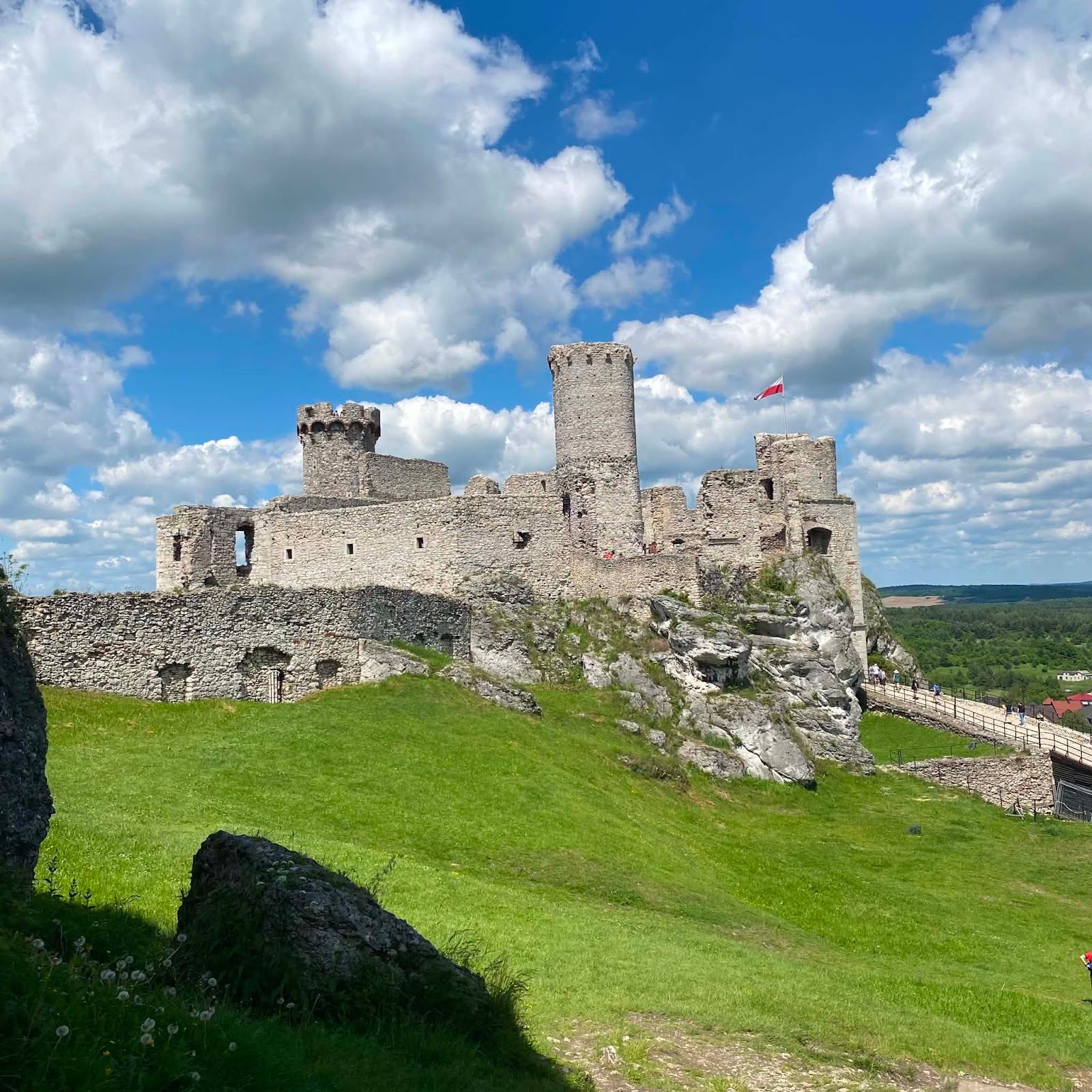
Ogrodzieniec Castle stands on Góra Janowskiego at 515.5 metres, the highest point of the Kraków-Częstochowa Upland. In Podzamcze the marked route crosses the outer bailey and the upper castle, and the only tower open to visitors is the Kredencerska Tower. The wooden stronghold on Mount Birów is a separate site about 1.5 kilometres away.
A ruin on the highest rock of the Upland
Góra Janowskiego is the hill under the castle, and the operator gives its height as 515.5 metres above sea level. The ruin is built on limestone and among limestone. From the hill it has always been easy to see across the country around Podzamcze. The same history page calls the site the largest and best-known castle in Silesia, and the most popular castle on the Trail of the Eagles' Nests.
The whole layout covers about 3.5 hectares. The defensive wall runs for about 400 metres. Two parts make the plan. The outer bailey once held stables, coach houses, a smithy, a brewery and a distillery. The upper castle held the kitchen, the well, bedrooms and the living and state rooms. The oldest masonry, called the High Castle, sits on the rock at the north side.
The municipality of Ogrodzieniec owns the ruin. Since 1995 the municipal company Zamek has run it. That is late in the story. In January 1945, during the Red Army's offensive, the walls took further serious damage. After the war the Polish state cleared the rubble, repaired and secured the masonry, carried out archaeological and architectural work, and marked a first visitor route. In 1973 the castle was opened to the public as a permanent ruin.
Owners, from a supposed wooden gord to the Firlej dowry
The history page is open about the earliest years. A wooden gord is supposed to have stood here in the 12th century, and it was probably burned by the Tatars in 1241. In the 14th century a wooden watchtower on nearby Mount Birów burned as well. King Casimir the Great then ordered a masonry castle on the present hill. With the other strongholds on the upland, that Gothic castle watched the south-western border of the Kingdom of Poland against Bohemia and the Silesian duchies. Przedbór of Brzezie kept it for the king. He later became marshal of the kingdom. The page says it is still unclear whether the old name "wilcza szczęka", wolf's jaw, meant this castle or the gord on Birów.
In 1386 King Władysław Jagiełło gave the royal castle to the knightly Włodek family of the Sulima coat of arms. Sales and marriages moved it through merchant, noble and magnate hands. In 1523 the previous owners' creditor took it for debt: Jan Boner, a banker, wielkorządca of Kraków, city councillor and salt official. His nephew Seweryn Boner inherited it and in 1530 began turning the Gothic castle into a Renaissance residence. The work ran from 1530 to 1545. After Seweryn's death his son Stanisław carried it on from 1550 to 1560. For the likeness, people called it a little Wawel. The history page says its splendour supposedly did not fall short of the royal castle in Kraków.
The 16th and 17th centuries are the years the operator treats as the castle's height. In 1561 Seweryn's daughter Zofia brought it as dowry to Jan Firlej, grand marshal of the Crown and voivode and starosta of Lublin. The Firlej family held it for over a century. Twice in those years an army got inside. In 1587 the Austrian troops of Archduke Maximilian Habsburg, a claimant to the Polish throne, took it and looted it. In 1655, during the Swedish Deluge, the troops of Charles X Gustav did the same and partly wrecked it.
Stanisław Warszycki, a magnate and wielkorządca of Kraków, bought the damaged castle after the Deluge. He rebuilt the weakened walls and, on the outer bailey, put up stables, coach houses and a heavy defensive wall. The history page also calls him a hard man who supposedly punished faults with cruelty. In 1702, in the Great Northern War, the Swedes of Charles XII took the castle again, looted it and set the fire it never recovered from. The Męciński owners rebuilt only the middle part. Left without further repair, the stronghold slid into a ruin.
In 1784 Tomasz Jakliński, a Kraków deputy judge, bought what was left and used castle stone for the nearby church in Ogrodzieniec. By 1810 the ceilings were in such bad condition that they might collapse. The last owner who lived there, Countess Zofia Mieroszewska, moved to a farm close by. Neighbours then took stone from the ruin for their houses. Treasure hunters and walkers came through. In 1885 the traveller Aleksander Janowski arrived. The history page says the beauty of these ruins moved him and his friends to found the Polish Tourist Society in 1906, and that this began the protection of the castle and of similar monuments. The hill carries his name.
The marked walk, from the dry moat to Kurza Stopa
The visitor plan starts once you are through the entrance gate and on the stone track toward the upper castle, across the wide outer bailey. On the left are an amphitheatre and a group of rocks, among them Wielbłąd, also called Kaczor or the Sphinx. Straight ahead is a reconstructed entrance gate. On the right, Niedźwiedź and Dwie Siostry are built into the curtain walls. In that rock group is a grotto called Męczarnia Warszyckiego. Beside it, in the old guardroom, is the torture exhibition, also called Katownia Warszyckiego. Reaching it means leaving the main track and climbing. The operator opens that room from spring to autumn. The tools named on the site are the Witch's Chair, the Spanish Boot, the garrote, Judas's Cradle and the Iron Maiden.
The main track continues over a wooden footbridge above the dry moat, where a drawbridge used to be lowered. The gate tower is the start of the numbered route. Through it you enter the Lord's Courtyard. From there the walk goes to the black kitchen, with the well and the scullion's room beside it, then back across the courtyard and up a spiral stair into the High Castle. The same stair leads down again, into a room with the next flight, up to a terrace above the well. A modern footbridge crosses over the black kitchen to another spiral stair and the owner's private rooms: Boner's bedroom and the library.
Stairs in the library reach a gallery and then the sideboard hall. From that hall you can enter the Kredencerska Tower, the only tower the plan opens to visitors, and drop one level into the knights' rooms, now called the dark store and the light store. Rock-cut stairs then climb to Kurza Stopa. The history page describes that wing as an added arm which enlarged the living rooms and strengthened the defence. Its third level is now open to the sky. A stair continues down through the two lowest levels. On the lowest, the plan points to the remains of Renaissance frescoes in the corners of the niches.
Kurza Stopa opens onto the service courtyard called Ptasznik. The history page says this smaller court was probably where poultry was kept. Reconstructed wooden cloisters hang on the curtain wall that closes the court on the south. The walk climbs that wall to the beluard bastion, the southern defensive corner, then passes under the convicts' tower onto an open terrace. A state room once stood there. The south tower, the history page adds, was also used as a prison. From the terrace the route aims at the stairs down to the old treasury, passing the gate tower again. On this level of the gate tower there was once a chapel, entered from the Lord's Courtyard through the galleries. The treasury looks back over the outer bailey. A footbridge leads to a modern spiral stair, past the powder magazine. The plan gives both the treasury and the powder magazine the number 14. The spiral stair returns you to the Lord's Courtyard, and the marked walk ends there.
Around that courtyard, cloisters once linked the floors. Rooms rebuilt along the sides used to be hajduk shops. A reconstructed cistern for rainwater stands in the middle. The kitchen level also had living rooms for the cooks. Under the kitchen, shooting cellars served as pantries. They are now the knight's inn, open only on holiday weekends. Higher floors once held bedrooms, a dining room, living chambers, the treasury, the armoury, the powder magazine and a storehouse. A second court, the tournament court, probably served as a garden as well as a defence. From the higher points, in good weather, the history page promises a view across the Jura and toward Czubatka, which it calls the highest summit of the upland and the crown of the castle hill.
The homepage ties the ruin to three films: Jerzy Passendorfer's Janosik, Andrzej Wajda's Zemsta, and, in 2019, the Netflix series The Witcher. On the ground, the same pages name Sunday-afternoon knight shows in the spring and summer season, plus field events including Najazd Barbarzyńców, the International Knight Tournament and Juromania, night events called ghost evenings and the Ogrodzieniec night of horror, and a balloon meet.
The wooden gord on the next hill
Mount Birów is the operator's reconstruction of a defensive settlement from the time of the first Piasts. Wood was the main material, with earth and stone. Ramparts and a palisade used the steep rocks and the drops. The last fortified gord on the hill was probably built in the 13th century, while Poland was split into duchies. At the turn of the 13th and 14th centuries Władysław Łokietek was fighting the Bohemian king Wenceslas for the throne in Kraków. The Birów page is inclined to blame Wenceslas for the burning of the gord. Archaeologists found a coin with his image there, and the page asks whether a Czech soldier brought it.
The open ground inside the wooden defences is the majdan, the daily ground of the gord, and a plan on site shows roughly where it lay. At that turn of the century the garrison was not large: a dozen warriors, or maybe several dozen, plus servants and traders. What the rebuilt gord shows today are themed displays in the settlement-owner's hut and in the warriors' tower, including objects from the digs. For schools and groups the operator also sells profiled visits, living history lessons, and a guided Walk through the Ages from the earliest occupation to the present.
The monadnock under the wooden gord is full of caves, cut by erosion of the soft limestone. Archaeological work has confirmed people here 30,000 years ago. Finds include fragments of reindeer antler, bones of the cave bear, flint tools, and the broken end of a polished bone point dated to the late Palaeolithic. Later objects run from antler and flint tools, spindle whorls and arrowheads to horseshoes and clay pots. The last settlement on Birów was early medieval and medieval, a Slavic one. At the foot of the hill is a barrow cemetery. A 1992 dig found three barrows and no human remains in any of them. The page compares that with a burial on top of a barrow, a practice known around the 7th and 8th centuries.
FAQ
Is Ogrodzieniec Castle accessible by wheelchair?
No. The operator says the castle is not adapted. There are many stairs, and wheelchair users can have serious trouble moving around.
How do I get to the castle without a car?
The operator says public buses run from Zawiercie to Podzamcze and that a taxi can be ordered in Zawiercie. No line number or stop name is printed in the FAQ. From Częstochowa, take the train to Zawiercie and continue by bus or taxi. From Kraków, go to Olkusz and continue by taxi. The castle ticket office is at ul. Zamkowa 28, 42-440 Podzamcze. The Birów ticket office is at ul. Partyzantów in the same village. Private car parks sit about 250 metres from the castle, mostly on ul. Krakowska. The FAQ gives PLN 10 for a car with no time limit, and PLN 15 for the first hour of a coach plus PLN 5 for each further hour, and says the prices can differ because the lots are private.
Who pays a reduced fare, and who gets in free?
The reduced fare, with the right document, covers children from their third birthday, pupils and students up to 26, pensioners, a Large Family Card household of two adults and at least three children, staff of other museums and cultural institutions, and disabled visitors. Free entry covers wheelchair users with a mobility disability, children until their third birthday (not organised groups), and one guardian for every ten pupils in a school or youth group up to 18.
How long does the visit take?
The operator estimates about 60 minutes for the castle on your own and about 90 minutes with a castle guide. Mount Birów on your own is about 30 minutes, plus the transfer between the two. The guided Walk through the Ages, covering the gord, caves, bunkers and the castle, is about three and a half hours.
Can I bring a pushchair onto the route?
Not around the whole castle. The operator says the stairs make that impossible and advises leaving the pushchair at the ticket office.
Can a dog come in?
Yes, at no extra fee, at the castle and at the Mount Birów stronghold. The dog stays on a lead. A large dog should wear a muzzle. The owner is responsible for damage and for cleaning up.
Does bad weather close the ruin?
The operator keeps the site open in rain unless a visit would threaten safety. In very bad conditions they decide to close.