National Museum in Kraków
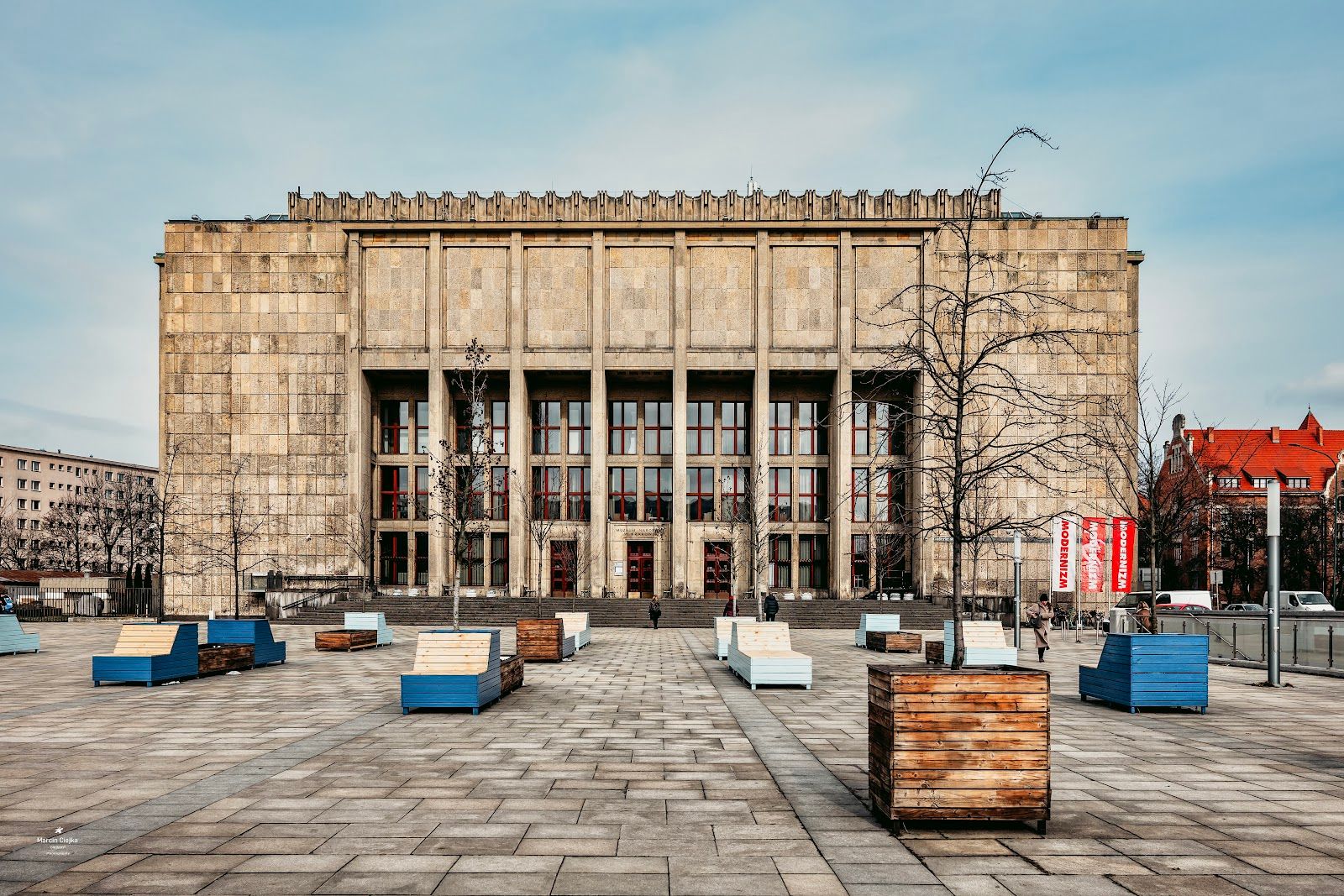
The Main Building of the National Museum in Kraków, at al. 3 Maja 1, holds three permanent galleries: 20th- and 21st-century Polish art, artistic craft, and European art. The building was designed in the 1930s and the construction, stopped several times, ran from 1934 to 1989. Tuesday is the free day for the permanent displays.
A museum finished in 1989
This page is the Main Building at al. 3 Maja 1, the card Google attaches to the National Museum in Kraków. The Cloth Hall gallery on the Market Square is a different branch. The museum says the idea of a main seat grew urgent in the first decades of the 20th century because the collection kept growing through purchases and gifts. After 1918 the project of a house for Polish art drew in the city authorities, citizens, artists and organisations. Construction, halted several times, ran with breaks from 1934 to 1989. Bolesław Schmidt, Czesław Boratyński and Edward Kreisler designed the building in the 1930s. The museum says the monumental front toward Błonia, and the interiors of the hall and the staircase, still carry the modernised classicism of those authorial designs.
The site is on a viewing axis. Piłsudskiego street comes out of the Planty and ends here. One way the museum names the Kościuszko Mound. The other way it names the towers of St Mary’s Basilica on the Main Market Square. The square in front of the building opens onto Błonia and sits against Aleja Trzech Wieszczów, the ring of streets around the centre. The museum describes that as the reason a walk toward the city’s green land now passes the door.
Three permanent galleries, and the shows that filled the halls
Inside, the permanent galleries are XX + XXI. Gallery of Polish Art, the Gallery of Artistic Craft, and the Gallery of European Art. Changing rooms take thematic exhibitions of works owned by the museum and works borrowed from other institutions and private collectors. The building is where the museum places its largest temporary shows. The branch history names “Polaków portret własny” in 1979, “Sztuka kręgu Sztuki” in 1995, “Między Giewontem a Parnasem”, and “Obrazy śmierci w sztuce polskiej XIX i XX wieku” in 2000. Shows of Marc Chagall, Andy Warhol and the French impressionists are cited as having drawn record crowds, and the impressionist exhibition is the one the page says drew over 140,000 people. The range the museum claims for the building runs from medieval craft and sacred art to avant-garde painting and sculpture of the 20th and 21st centuries.
Monographic shows, built around one artist, are described as a separate habit, often opened only after research and conservation. The names given are Piotr Michałowski, Ferdynand Ruszczyc, Stanisław Wyspiański, Leon Wyczółkowski, Olga Boznańska, Tamara Łempicka, Jacek Malczewski and Jan Matejko. A study display of the Wyspiański holding, the largest single collection of his work in the museum and over a thousand objects, has been shown in a room on the second floor as a store visitors can enter, one third of the objects at a time so the pastels can rest. Family trails sit on the permanent galleries and the temporary shows. Lectures, curator tours and meetings run with the exhibitions. The MNK library and reading room are in the building, and so are the director’s offices, the conservation studios for painting, sculpture, craft, textiles, frames, gilding and furniture, and the workshops that serve all twelve branches.
FAQ
Can a wheelchair get through the Main Building?
The museum says the building is almost fully reachable by wheelchair or crutches, using lifts, stair platforms and portable rails, except the cloakroom and the mezzanine on the second floor. An external lift is at the main entrance. The entrance doors have strong closers. Accessible toilets are on the ground floor and the second floor. Changing tables are in the ground-floor toilet and by the cloakroom on level −1. A sounding tactile board in Polish, English and Ukrainian, visitor wheelchairs, audiodescription and a guide for deaf visitors are listed. A paid municipal underground car park at the entrance has marked disabled bays, and two further disabled bays are near Błonia.
Which stop, and is Tuesday really free?
Buses 109, 124, 134, 144, 152, 164, 169, 173, 179, 194, 249, 304, 424, 502 and 503, and trams 1 and 20, stop at Muzeum Narodowe. The museum does not give the walk from the stop. Tuesday is the free day for permanent displays. Temporary exhibitions are a separate tariff, PLN 35 normal and PLN 25 reduced. Permanent displays are PLN 45 and PLN 35 on other days, with pupils and students at PLN 1.
When is the last entry, and which days in 2026 is the building shut?
Last entry to the galleries is 20 minutes before closing. The usual hours are Tuesday to Sunday 10:00–18:00, Monday closed. In 2026 the museum lists full closures on 1 January, 4, 5 and 6 April, 4 June, 1 November, 24 December and 25 December. On 31 December the Main Building is open 10:00–14:00. Several public holidays shorten the day to 10:00–16:00. The reservation desk is +48 12 433 57 44, rezerwacja@mnk.pl.