Main Market Square
Kraków's Main Market Square was laid out in 1257 as a square of about 200 metres on each side, where older trade routes crossed. UNESCO describes this merchants' town as having Europe's largest market square, and the city places the Cloth Hall in the middle of it. The same ground is where Kraków records the Prussian Homage, Kościuszko's oath and the Lajkonik procession.
A square measured in 1257
Kraków's Main Market Square, Rynek Główny, was set out in 1257 where older trading routes crossed. The city describes the plan as a square with sides of about 200 metres. The name Rynek (Ring) appears around 1300. Official lists called it Rynek Główny only from 1882, when Kraków unified the names of its streets and squares.
The layout is the checkerboard of a medieval chartered town. Three streets leave each frontage. Grodzka is the exception. It follows an older trade route beside the Church of St Adalbert, so it runs at an angle and widens. Those bends exist because some buildings already stood when the lines were drawn. The city still calls the result simple and functional. UNESCO links that clarity to the Magdeburg-law charter: later changes to individual plots did not redraw the street network.
Trade, the town hall and the church
The square was Kraków's main public room. The Town Hall carried municipal business, the Cloth Hall the trade, and St Mary's Church the religious life of the place. From St Mary's tower the hejnał is played every hour to all four sides, a practice the city says has run for 600 years. A circuit here is a reading of that split, not a lap around an empty plaza.
Stalls gradually covered the open ground. They were split into separate markets: salt, coal, poultry, lead, fish, cooperage and others. The city describes that building as generally chaotic. The floor people cross today is what remained after a later clear-out.
What the 19th century left standing
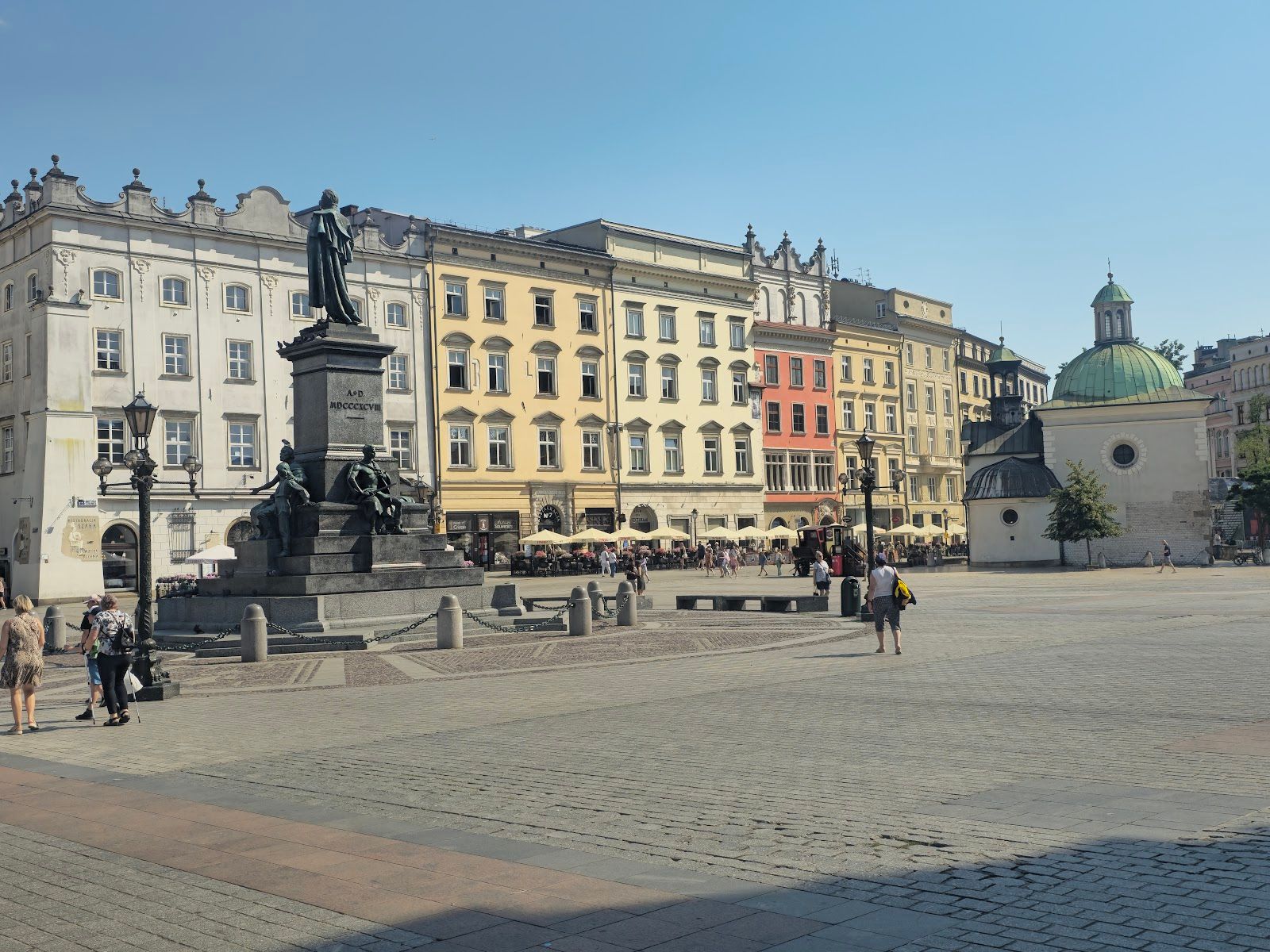
In the 19th century the municipality made tidying Kraków a programme, and the main square was one of its priorities. Stalls and annexes around the Cloth Hall came down. So did the Small Weigh House and the Great Weigh House. Most of the Town Hall was demolished. The tower stayed. The Adam Mickiewicz Monument was unveiled in the same campaign. The city says the square then took on a look close to the one it has now.
A 2026 mayoral order defines the managed square as the plate, the roadway and pavement around it, and the arcades of the Cloth Hall. The same order names objects the city keeps on that cleared ground: Igor Mitoraj's sculpture, commemorative plaques set into the paving, the Walenty Badylak well and the fountain. Horse carriages have a marked stand on the left side of the roadway, along the edge of the plate, between Szewska and św. Jana. The order caps that stand at 18 places. UNESCO lists the Town Hall Tower among the landmarks that still define the historic centre's panorama.
A public stage
The city treats the square as a stage for national events. In 1525 the Prussian Homage was held here, closing what the city calls a 300-year run of disputes and wars with the Teutonic Order. Tadeusz Kościuszko's oath on the square is the moment the city uses for the formal start of the Kościuszko Uprising. In 1981 the White March filled the square after the attempt on Pope John Paul II's life. In 2004 fireworks marked Poland's entry into the European Union.
Local customs use the same floor. The city names the Lajkonik procession with its mlaskoty band, the competition of Kraków nativity scenes, and the enthronement of the Fowler King. The nativity-scene tradition, szopka, is also entered under the 2003 Convention for the Safeguarding of the Intangible Cultural Heritage, noted on UNESCO's page for the Historic Centre.
The square inside the 1978 inscription
Rynek Główny sits in the Historic Centre of Kraków, inscribed in 1978 under criterion (iv). UNESCO defines the property as three linked ensembles: the medieval chartered city, the Wawel Hill complex, and Kazimierz including the suburb of Stradom. It describes an accumulation of architecture from the early Romanesque period through to Modernism, and the extraordinary density of monuments kept with their fittings. The inscribed area is 149.65 hectares, with a buffer of 907.35 hectares added in 2010. The square is the core of the chartered town inside that property, not a separate listing.
The city files the square under the Royal Route, at the address Rynek Główny. UNESCO calls the Wawel Hill ensemble the dominant feature of the historic centre that contains this square.
FAQ
How do I get to Main Market Square?
Do not plan to drive in. Rynek Główny and the adjoining streets are a restricted-traffic zone signed B-1, so private cars are generally banned. In September 2025 the city enlarged those signs and painted the symbol on the road surface. Listed exceptions include taxis, horse carriages, trips to a property or a reserved bay, and deliveries only while loading. A permit to stop beside the plate does not allow a vehicle onto it: the 2026 mayoral order requires separate consent from the City Roads Authority. The full exception list is on the board under the sign.
Is Main Market Square accessible?
The city describes the central space as easily accessible for people with special needs. The public toilet at the Cloth Hall, on Rynek Główny, is listed as adapted for disabled visitors, with a platform, and is open daily from 8:00 to 2:00.
Is there a ticket for the square?
The city page for Rynek Główny publishes no admission price.