
Krupówki Street
Zakopane's official walk along Krupówki and Zamoyskiego is 1.9 km, with a printed finish time of 30 minutes. The promenade itself is about 1 km, named for the Krupówki glade that once belonged to the Krupa family. The route starts at the Kościeliska junction and ends by the 1903 monument to Tytus Chałubiński.
A promenade that does not end at the monument
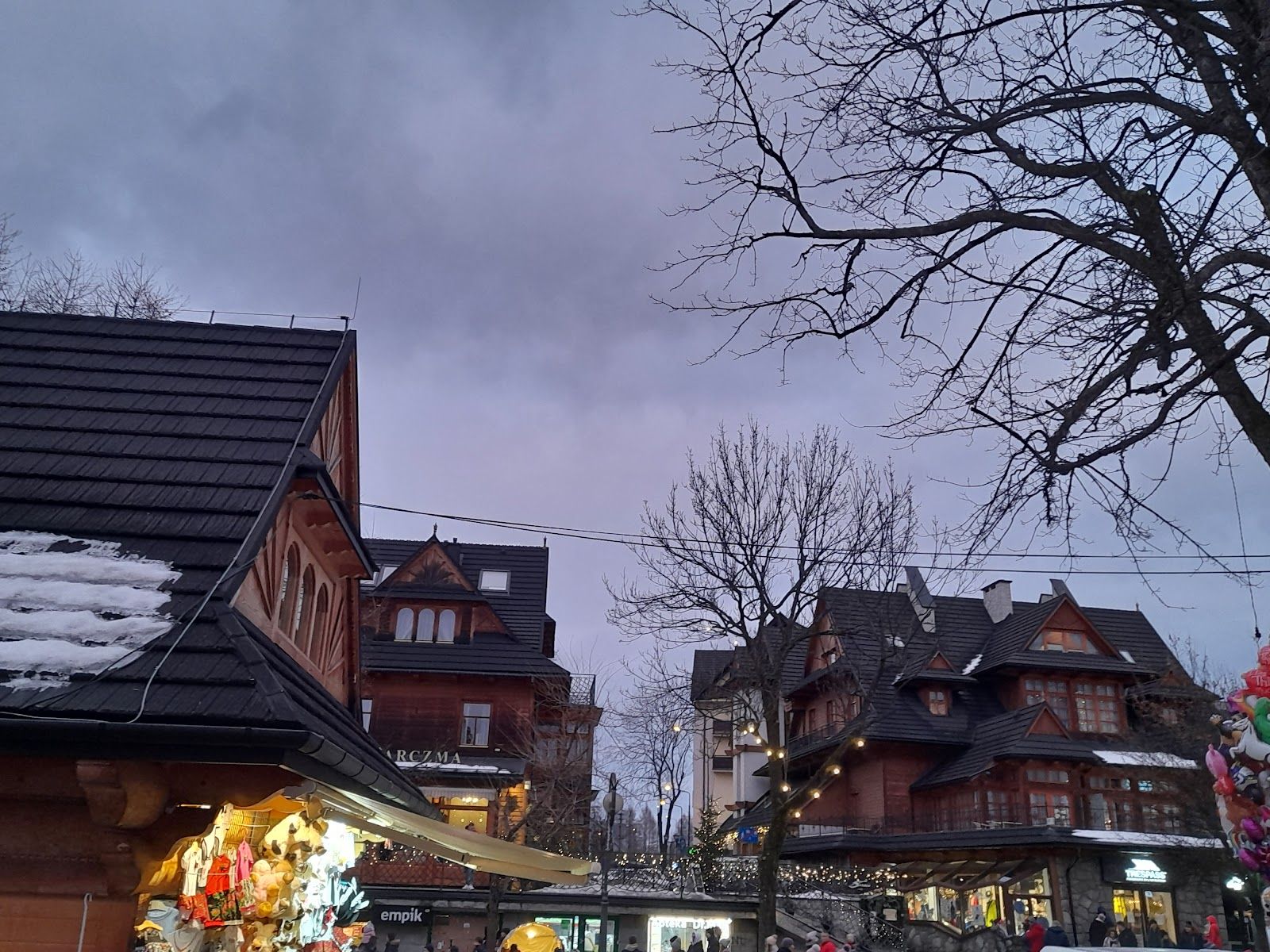
Krupówki is the street Zakopane calls its showcase. The city's walking page puts the promenade at about 1 km and says it fills with visitors in the high season. The name comes from the Krupówki glade, once owned by the Krupa family. By the end of the 19th century the wooden houses on both frontages were giving way to masonry townhouses. The published walk is longer than that promenade: 1.9 km, with a finish time of 30 minutes, starting at the lower end where Krupówki meets Kościeliska and continuing uphill until the street becomes Zamoyskiego.
The church at 1a and the museum at 10
The first building on that route is the Sanctuary of the Holy Family at Krupówki 1a. Father Józef Stolarczyk, Zakopane's first parish priest, began it in 1877. Father Kazimierz Kaszelewski finished it. The church was consecrated in 1899 and then took the parish rank that had belonged to the wooden Old Church on Kościeliska. The city describes a Neo-Romanesque stone building marked by the Zakopane style, by Edgar Kováts's "Zakopane way," by mock Baroque and by early 20th-century Art Deco. Inside, it credits Stanisław Witkiewicz with the altar in the side chapel of Our Lady of the Rosary, in the left aisle, the side chapel of St John the Baptist, and the main door.
The Tatra Museum stands at Krupówki 10, on the right, set slightly back from the street. The masonry building, in the Zakopane style, went up from 1913 to 1922. Witkiewicz designed the façade. Franciszek Mączyński drew the technical plans. The city lists three permanent exhibitions: the history of the region, its ethnography, and its natural history. Close by are the Tatra Station building at Krupówki 12 and the Zakopane Vocational and High School of Construction Trades.
The gallery over the old bazaar
Uphill, at the junction with Weteranów Wojny, the Count Zamoyski Municipal Art Gallery occupies Krupówki 41. The city ranks it among the oldest art galleries in Poland and ties it to the Polish Bazaar. In July 1911 a graphics exhibition was held there, organised as a competition by Henryk Grohman, an industrialist from Łódź and a co-founder of the Podhale Art Association. The room above the bazaar, built with the Count Zamoyski Foundation of Kórnik, became an arts centre. The city names exhibitors including Władysław Skoczylas, Wojciech Brzega, Stanisław Ignacy Witkiewicz, Teodor Axentowicz, Xawery Dunikowski, Julian Fałat, Rafał Malczewski and August Zamoyski. Witkacy's Formist Theatre worked in the same building. The gallery now shows contemporary Polish art, and the city also lists author meetings, film screenings, poetry evenings, chamber concerts and art fairs.
Past the monument, onto Zamoyskiego
The promenade meets the monument to Count Władysław Zamoyski and from there the walk is on his street. About 1.6 km from the start, set slightly back on the left, is Villa Oksza at Zamoyskiego 25, a branch of the Tatra Museum and a gallery of 20th-century art. The city calls it the third design by Stanisław Witkiewicz in the Zakopane style. The design is dated 1894–1895, for Bronisława and Wincenty Korwin-Kossakowski. Highland carpenters under Wojciech Roja and Jan Obrochta built it in 1895–1896. The interior woodwork, doorways and crossbeams are part of that style. Temporary shows use the first floor. A separate room holds portraits by Stanisław Ignacy Witkiewicz, Witkacy. The city names paintings by Rafał Malczewski, Wanda Gentil-Tippenhauer and Zofia Stryjeńska among what is on view.
Further along Zamoyskiego the walk passes the Church of the Holy Cross, seat of the Tatra parish, whose patron is St Brother Albert. It was built from 1983 to 1991 to a design by Witold Cęckiewicz, who also designed the interior. The city says the annual pilgrimages to the cross on Giewont set out from this church. The route ends at the fork of Zamoyskiego and Chałubińskiego, in woodland that belonged to the Chałubiński family. The monument to Dr Tytus Chałubiński was unveiled in 1903. Witkiewicz designed it. Jan Nalborczyk sculpted the bust and the figure of Sabała beneath it. The city calls Chałubiński, who came from Radom, the discoverer of Zakopane, and describes Jan Krzeptowski Sabała as a 19th-century mountain guide, hunter, storyteller and folk musician who led artists into the Tatras.
How to get there
Zakopane municipal buses 10, 11, 12, 13, 14, 15, 16 and 18 stop at Krupówki Pomnik hr. Wł. Zamoyskiego.
FAQ
Is there a ticket to walk Krupówki?
The city's walking page does not list a charge for the promenade. It publishes the route as a street walk.