Kościuszko Mound
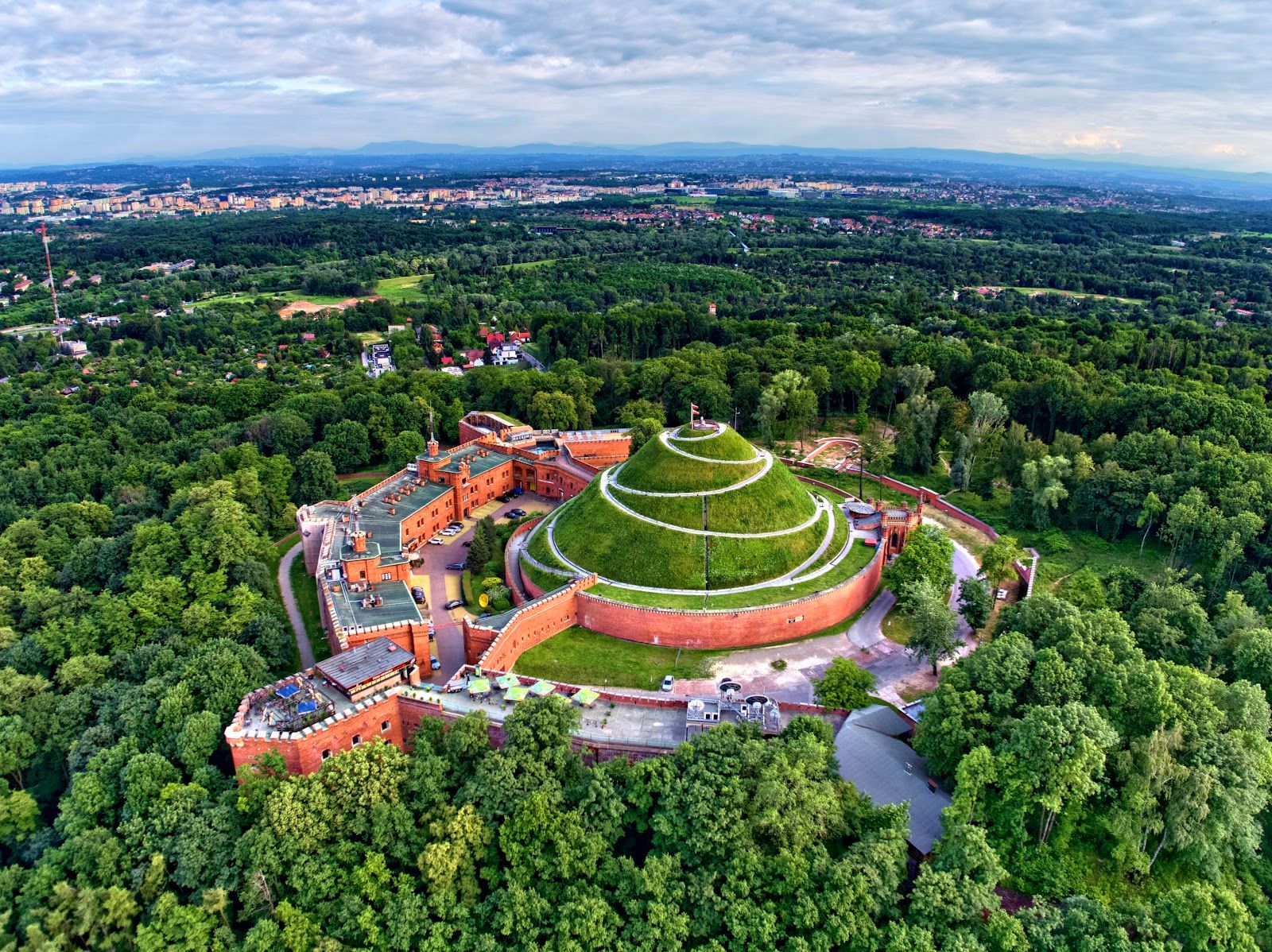
The Kościuszko Mound on Sikornik Hill is 34 metres high, and the site calls it the first monument in the world raised for Tadeusz Kościuszko. Nineteenth-century Fort 2 Kościuszko rings the earthwork. From the top the visit page names Wawel Castle, St Mary’s Basilica, the Cloth Hall and the Main Market Square.
An earthwork inside a citadel fort
The mound stands on Sikornik Hill in Kraków. The guided-tour page calls it the first monument in the world put up in honour of Tadeusz Kościuszko, and it gives the height as 34 metres. The visit page does not explain why the form chosen was a mound. What it does describe is the fort wrapped around it: Fort 2 Kościuszko, a 19th-century citadel fort, one of the oldest surviving parts of the Kraków Fortress, built with a defensive job. Guides on the way up cover the construction of the mound and the Austrian fortifications around it. The address of the committee that runs the place is al. Waszyngtona 1, 30-204 Kraków.
The panorama the visit page lists from the summit is Wawel Castle, St Mary’s Basilica, the Cloth Hall and the Main Market Square, then the Kraków Upland, the Sandomierz Basin and the Wieliczka Foothills. In good visibility it adds the Tatra Mountains. The same page says the grounds also hold memorials to outstanding Poles, and a wax-figure exhibit where you stand in front of those figures. That wax room is in a historic building. The accessibility page says access to it is limited for that reason.
Kościuszko – a Hero for Our Times
The permanent exhibition is in the historic interior of the fort. The museum project page places it in Bastion V of Fort 2. The exhibition page tells the life as a sequence of chambers, not as a row of cases. It uses film, theatre and the mechanics of a computer game, and it also puts original objects in the foreground. The order on that page runs from the young man’s start in life, through an unfulfilled early love, a journey to America and what the exhibition page calls the Civil War, then the war with Russia in 1792. The guided-tour page names the American chapter the War of Independence of the United States, and it carries the story on to his death in Solothurn. Both pages put the peak at the oath on Kraków’s Main Market Square on 24 March 1794, and at his taking command of the uprising.
The last stretch of the exhibition is not another battle. The page says national tradition wrapped Kościuszko in a halo, bronze and patina, and that the closing rooms try to set that figure against the present. A separate children’s route uses games, labyrinths, postcards and drawing boards. After the fort wall there is a playground with a Kościuszko Tower, and a café for coffee, ice cream and desserts.
From the fort wall to the summit
The path from the exhibition to the observation deck beside the mound can be the lift. From there the road to the top has no thresholds and no stairs. The visit page still calls that road quite steep. Bastion V and Curtain I–V are the conference and temporary-exhibition pavilion on the same fort.
How to get there
Bus 100 from Salwator and bus 101 from Rondo Grunwaldzkie. The accessibility page says the vehicles have wheelchair ramps.
FAQ
Can a wheelchair reach the top?
The main exhibition is fully adapted. A lift runs from it to the observation deck beside the mound. The road to the top has no thresholds and no stairs, and the accessibility page calls it quite steep. Bastion V and Curtain I–V have a lift, an elevating platform and accessible toilets. The wax-figure exhibit is in a historic building and access to it is limited. Reduced tickets need a disability document. For a larger group of wheelchair users the same page says to tell MPK Kraków so they can send a suitable bus.
What does the entry ticket cover?
The mound and all permanent and temporary exhibitions in Fort 2, including the collections and installations in the historic interior. Night tour PLN 35. Free on 4 February, 24 March and 15 October. Kraków Tourist Card accepted. Animals are not allowed in, for security reasons. Cash, cards, contactless cards and foreign currency are accepted.
How do you arrive if you are not on bus 100 or 101?
By car or coach, use ul. Księcia Józefa and ul. Malczewskiego. Parking for cars and buses is free. On foot, start at Salwator, go up ul. Św. Bronisławy, then al. Waszyngtona. Salwator is served by buses 109, 209, 229, 239, 249, 259, 269 and 409, and by trams 1, 2 and 6. A bicycle stand is by the ticket office, and the office lends chain locks at no charge.