Cloth Hall & Sukiennice Gallery
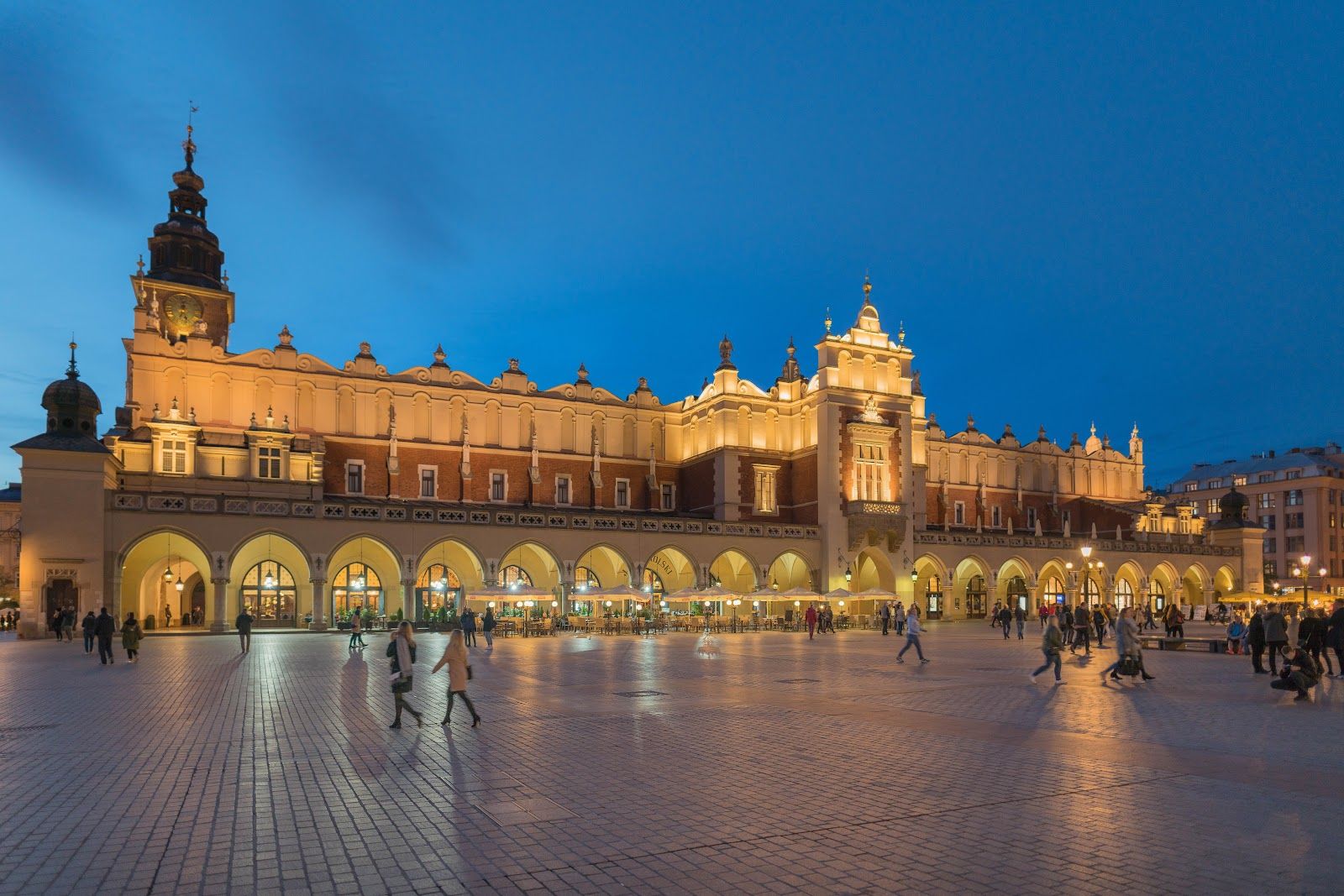
The Gallery of 19th-Century Polish Art fills the first floor of the Cloth Hall on Kraków’s Main Market Square. The hall was a trading building from the 13th century, rebuilt in the Renaissance in the mid-16th century. Henryk Siemiradzki’s Nero’s Torches, given in 1879, was the founding picture of the National Museum.
A market hall that became the first National Museum
The National Museum calls the Sukiennice a former shopping hall, built in the middle of the Main Market Square in the 13th century. The stalls were enlarged in the Gothic style in the 14th century and thoroughly rebuilt in the Renaissance in the middle of the 16th. Between 1877 and 1879, under the partitions, the building was restored in a historicist spirit. The old shops were given formal uses: balls and patriotic celebrations. At one of those celebrations a resolution set the first-floor halls as the first seat of the National Museum in Kraków.
On 7 October 1879 the city council established the first National Museum in Poland. The exhibition page ties the founding gift to the 50th anniversary of Józef Ignacy Kraszewski’s work, celebrated in these rooms in 1879, when Henryk Siemiradzki gave Nero’s Torches to the public. The canvas shows the persecution of the first Christians, painted when Poland was not on the map. Other artists then added several dozen works. The inaugurating exhibition opened on 11 September 1883, the eve of the 200th anniversary of the Battle of Vienna, in two halls on the first floor from ul. Bracka. The first director was Władysław Łuszczkiewicz, 1883–1900, then Feliks Kopera, 1900–1949. In 1901 the museum took the whole floor. In 1902–1903 a modern gallery was fitted and stayed almost unchanged until 1939, mixing art and craft from the 15th to the 19th century, later 19th-century painting and sculpture, drawings, national memorabilia, archaeology and ethnography. Activity stopped for several months in the First World War and for five years, 1939–1945, in the Second.
In 1950–1956 a new hang showed only Polish painting and sculpture from the Enlightenment to the end of the 19th century. That range held into the 1970s, when Mieczysław Porębski, Andrzej Pawłowski and Jan Kolanowski reshaped the gallery. After 2000 the rooms were renovated and the museum gained space on the ground floor, the mezzanine and the terraces. The present permanent layout is the concept of Barbara Ciciora-Czwórnóg and Aleksandra Krypczyk-De Barra. Jacek Cupryś made the design changes. The branch page says the show now covers the Enlightenment, Romanticism, academic art, and late-19th-century Realism, Impressionism and the early phase of Young Poland.
Four rooms, four patrons
The rooms follow the century, and the museum assigns each a patron: Marcello Bacciarelli, Piotr Michałowski, Henryk Siemiradzki and Józef Chełmoński. The Bacciarelli Room is Enlightenment painting and sculpture, late Baroque, Neoclassicism and Sentimentalism, under King Stanisław August Poniatowski: portrait, allegory and history. The names on the page are Bacciarelli, Józef Grassi, Jan Chrzciciel Lampi, Aleksander Orłowski, Jan Bogumił Plersch, Franciszek Smuglewicz and Jakub Tatarkiewicz.
The Michałowski Room is Romanticism, which the page dates from the end of the 17th century to the middle of the 19th, and which it ties in the Polish lands to the fall of the state and the uprisings. Artists listed: Artur Grottger, Leon Kapliński, Piotr Michałowski, Henryk Rodakowski, Józef Simmler, Wojciech Korneli Stattler, Michał Stachowicz, Teodor Baltazar Stachowicz and Józef Suchodolski. Michałowski’s Somosierra is the battle on the pass, which the page reads as the fight for freedom, lonely heroism, comradeship and patriotism.
The Siemiradzki Room is the academic and salon art of the second half of the century, when the hierarchy of subjects ran from history, biblical or national, down through portrait, genre, landscape and still life. The two monumental canvases named are Siemiradzki’s Nero’s Torches and Jan Matejko’s Kościuszko at Racławice. Also in the room: Tadeusz Ajdukiewicz, Kazimierz Alchimowicz, Feliks Cichocki-Nałęcz, Wojciech Gerson, Hipolit Lipiński, Matejko, Jacek Malczewski, Maksymilian Antoni Piotrowski, Witold Piwnicki, Pius Weloński, and others. The page sets Matejko’s Wernyhora next to Malczewski’s Death of Ellenai.
The Chełmoński Room is the last stretch: Realism, Polish Impressionism and the start of Symbolism. The axis of the room ends on Chełmoński’s Four-in-Hand, a team of horses coming at the viewer. Realism is tied to the Warsaw School of Fine Arts and the Drawing Class: Rafał Radziewicz, Franciszek Kostrzewski, Wojciech Gerson, Henryk Pillati and Józef Szermentowski. Genre painting of gentry, townspeople and peasants is represented by Józef Brandt, Aleksander Kotsis, Kostrzewski, Witold Pruszkowski and others. The portrait turns intimate, as in Anna Bilińska-Bohdanowicz’s Self-Portrait. Landscape painters trained in Munich and Paris include the Gierymski brothers, Jan Stanisławski, Józef Pankiewicz, Władysław Podkowiński and Leon Wyczółkowski. Malczewski’s Introduction and Inspiration of the Painter, and Podkowiński’s Ecstasy beside them, are the page’s bridge to the 20th- and 21st-century gallery in the museum’s Main Building.
How to get there
The museum lists buses 124, 152, 424 and 502, and trams 1, 2, 3, 4, 6, 8, 10, 13, 14, 18, 20, 24 and 52. The address is Rynek Główny 3.
FAQ
Is the lift working?
The notice on the branch page says it is out of service because of a fault. The same page describes an elevator with Braille buttons to the gallery and the terraces, a ground-floor entrance with no thresholds, a second cloakroom with lockers at the shop because the main cloakroom is up stairs, a tactile and sound board in Polish, English and Ukrainian, a gentle ramp to the terrace, and a disabled toilet near the terrace and café. Stairs to that toilet are covered, when needed, by a mobile aluminium ramp. There is a defibrillator, a changing table, audio description and a sensory basket. The page does not say when the lift will be back.
Which door, and which lines stop nearby?
The address is Rynek Główny 3, 31-042 Kraków. The published lines are buses 124, 152, 424 and 502, and trams 1, 2, 3, 4, 6, 8, 10, 13, 14, 18, 20, 24 and 52. The page does not name the stop. The ticket office is 12 433 54 03. The branch email is sukiennice@mnk.pl.
What is on the first floor, as against the market stalls?
The permanent gallery is 19th-century Polish painting and sculpture, in four rooms patronised by Bacciarelli, Michałowski, Siemiradzki and Chełmoński. The ground-floor hall is the old trading space. The museum also uses the mezzanine and the terraces. Tickets are PLN 35 or PLN 25, and PLN 1 for ages 7 to 26.