Auschwitz-Birkenau Memorial
About 1,100,000 people were murdered at Auschwitz, and about 900,000 of them were killed in the gas chambers on arrival and never registered. The memorial in Oświęcim keeps Auschwitz I, the prewar barracks, and Auschwitz II-Birkenau, built from 1941 on the village of Brzezinka. Survivors founded the museum in 1947 to preserve what remained of the camp.
Oświęcim, 1940
Germans established the camp in 1940 in the suburbs of Oświęcim, a Polish city they annexed to the Third Reich and renamed Auschwitz. That name became Konzentrationslager Auschwitz. In April 1940 Heinrich Himmler ordered a concentration camp in the former artillery barracks. The first transport of political prisoners left Tarnów prison and reached the camp on 14 June 1940: 728 Poles, including a small group of Polish Jews. The museum treats that day as the start of the camp. From 1940 to 1945 about 405,000 prisoners were registered, 270,000 of them men. The UNESCO page on the same museum rounds the registered prisoners to 400,000, Jews and Poles in the majority, with Roma and Sinti, Soviet prisoners of war, and others. That count leaves out the people murdered on arrival. The museum estimates about 900,000 such victims, and about 1,100,000 victims in all.
The camp began as one of the concentration camps Nazi Germany had been building since the early 1930s, because arrests of Poles had outgrown the local prisons. From 1942 it was also the largest of the centres where the murder of European Jews was carried out. The museum states it was the largest concentration camp of the German Third Reich, the one with the most victims, and the only concentration camp that at the same time was a centre of systematic killing in gas chambers. On 19 June 1940 the first local people were removed so they would not see the crimes, contact prisoners, or help escapes. In all, at least 5,000 Poles were moved from Oświęcim and nearby villages, and the Jewish population of Oświęcim, about 7,000 people, was deported to ghettos. Eight villages were destroyed and over a hundred buildings demolished. The first escape was Tadeusz Wiejowski on 6 July 1940. Of over a million deportees, a few hundred tried to escape, mostly Poles, Soviets and Jews, and about 150 got out. The first shooting execution, on 22 November 1940, killed 40 Poles.
The museum was created in 1947 on the former grounds, on the initiative of survivors, to keep the remains, commemorate the victims, and do research and education. Poland had it entered on the UNESCO World Heritage List in 1979, on the condition that it be the only camp on the list and stand for the others. In 2007 the inscription title became Auschwitz-Birkenau. German Nazi Concentration and Extermination Camp (1940-1945). The site is in Oświęcim County, Małopolska, reference 31, criterion (6).
Auschwitz I
Auschwitz I is the oldest part, the main camp, set in the prewar Polish barracks. The number of prisoners there moved around 15,000 and sometimes rose above 20,000. Zyklon B was first used in the camp on 3 September 1941, in the cellars of Block 11, to kill 600 Soviet prisoners of war and about 250 sick Polish prisoners. Late that September the mortuary by the crematorium was rebuilt as a gas chamber: four openings in the beam, short chimneys, lids lined with felt. It was used when the number of people to be killed was small. The furnaces could burn 200 bodies a day at first, and 340 after a third furnace was added. That gas chamber was used for the last time in December 1942. The ovens ran until July 1943. A guided tour lasts about three and a half hours and starts at this camp. On the ground, the Auschwitz I circuit is about 1,300 metres. It begins with a passage of nearly 600 metres, and part of that passage is a tunnel of almost 300 metres that rises. Block 4 contains a room with the hair of victims.
Birkenau
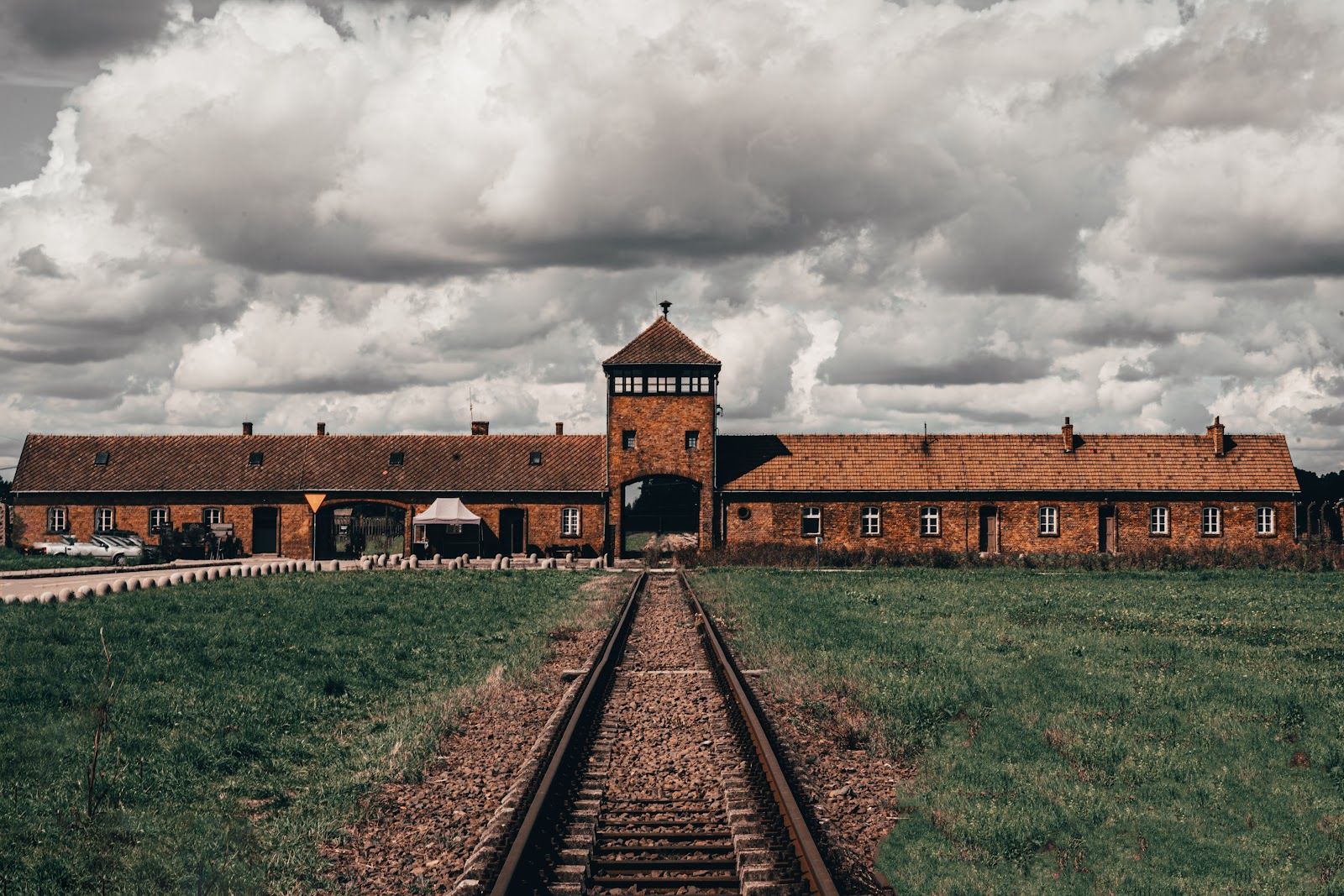
Birkenau, Auschwitz II, was the largest part of the complex. Building started in 1941 on the village of Brzezinka, three kilometres from Oświęcim. The Polish inhabitants were evicted and their houses taken and demolished. The camp started functioning on 1 March 1942. In 1944 it held over 90,000 prisoners. Most of the apparatus of mass killing was built here, and most of the victims were murdered here. The two sites as they stand are 3.5 kilometres apart. Between them, about three kilometres by ul. Więźniów Oświęcimia, Jaracza, Leszczyńskiej and Męczeństwa Narodów, are the remains of railway sidings and the Alte Judenrampe, where trains of deportees stopped and SS men made selections. In 1942 that ramp, between Auschwitz I and Birkenau, took transports of Jews, Poles, Roma and Sinti, and prisoners of other nationalities.
In March 1942 a house at the edge of the wood in Brzezinka, taken from an evicted Polish family, was turned into a gas chamber, called Bunker I. The windows were walled up and a door fitted by about 23 March. A second farmhouse outside the fence of the camp, then still being built, was in use from spring 1942. Rudolf Höss put its capacity at about 800 people at a time, with two undressing barracks. Another house, adapted in mid-1942, he put at 1,200, with three undressing barracks. Both were taken out of use in spring 1943 after the new crematoria opened. The second was brought back in spring 1944 during the murder of the Hungarian Jews. Four large gas chambers and crematoria went into operation between 22 March and 25-26 June 1943. At crematoria II and III the gas chambers and undressing rooms were underground. At IV and V they were at ground level. About 2,000 people at a time could be killed in each. On 28 June 1943 the Zentralbauleitung calculated 4,416 bodies a day: 1,440 each in II and III, 768 each in IV and V, which is over 1.6 million a year. Prisoners assigned to the burning stated a higher daily figure, about 8,000. Crematorium VI was never built past the plan. The International Monument to the Victims of the Camp stands by the ruins of gas chambers and crematoria II and III, on several levels of cobblestones. The entrance from ul. Ofiar Faszyzmu 12 is through the Death Gate, at ground level. The Sauna, 1.5 kilometres from that entrance, is closed to tours because of roof repairs. A circuit of Birkenau is over 2,000 metres.
Auschwitz III and the zone around the wire
Between 1942 and 1944 the Germans founded over 40 sub-camps, using prisoners as slave labour, mostly at German industrial plants and farms. The largest was Buna, also called Monowitz, about 10,000 prisoners, opened in 1942 at the Buna-Werke synthetic rubber and fuel plant six kilometres from the camp. IG Farbenindustrie built the plant. The SS supplied the prisoners. In November 1943 Buna became the seat of the commandant of Auschwitz III, and the other industrial sub-camps were put under it. The first of those sub-camps, Golleschau, started in July 1942 by the cement works at Goleszów near Cieszyn. In 1942-1944 the calendar counts 47 sub-camps and external work squads. The SS fenced the camps off from the outside world. The area the commandant administered was larger: about 40 square kilometres, the Interessengebiet, around Auschwitz I and Birkenau. About a thousand homes of the evicted Poles and Jews were demolished. Other buildings went to SS officers. The camp used the zone for workshops, stores, offices and SS barracks.
How to get there
Lajkonik buses from Kraków stop at the Museum car park (ul. Więźniów Oświęcimia 55). The Memorial is about 1,500 metres from Oświęcim railway station.
FAQ
Can a wheelchair cover both camps?
The whole site is a listed monument, and the museum says adaptations are limited. The car park at ul. Więźniów Oświęcimia 55 has disabled bays and accessible toilets. The Visitors Service Centre has ramps, an indoor platform, floor paths for visually impaired visitors, and accessible toilets. Wheelchairs and walkers are free: ask ahead by email, or at the entry-passes desk on the day if one is free. The shuttle between the camps has a wheelchair platform. At Auschwitz I the surfaces are uneven and most buildings are reached by historic stairs, so wheelchair tours stay on the ground floors. Wheelchair users cannot enter the upper floors or the basement of Block 11. At Birkenau the Death Gate tower is closed to wheelchairs. Assistance dogs, signal dogs and guide dogs may enter with a training certificate and a valid vaccination record.
Where is an entry pass issued?
The individual-visitors page says a personalised pass is required for both camps, that reservations are only at visit.auschwitz.org, and that no cards are sold at the entrance. The booking page says that site is the only official one and that the museum does not sell passes through outside firms. It also says every visitor needs the named pass and an identity document, that individual passes cannot be changed or refunded, and that a free pass without an educator must be reserved online no later than seven days ahead, or until that pool is gone. The visitor regulations of 1 July 2026 also say passes can be booked on the website and at the Visitors Service Centre.
What will get a visitor turned away?
The museum does not recommend the visit for children under 14. A facility near the museum can look after children during a visit. Bags taken onto the grounds may be no larger than 35 by 25 by 15 centimetres. Prams are not allowed into the blocks. Visitors must dress for a place of remembrance and follow the educators. Photography and filming with flash or a tripod are forbidden, and they are forbidden entirely in Block 4, Room 5, and in the basement of Block 11. Food, alcohol and smoking are forbidden on the grounds. Candles are allowed only at the Execution Wall in Auschwitz I and at the International Monument in Birkenau.